
Unified Assessment of Stability, Aggregation, and Phase Separation.
Eliminate the uncertainty of late-stage scale-up. Labbot brings future manufacturing stresses into your discovery workflow, allowing you to de-risk candidates early and hand over high-quality assets that won't surprise you with instability years from now.

Trusted by Leading Labs around the World


The Active Biophysical Reactor for Industrial Formulation
Don’t let your discovery success become a late-stage liability. Labbot pulls future manufacturing stressors into your current workflow, transforming a static sample into a dynamic simulation.
By recording a gap-free record of conformational and colloidal stability simultaneously, you eliminate the uncertainty of scale-up and ensure your most valuable assets reach the clinic without surprise failures.
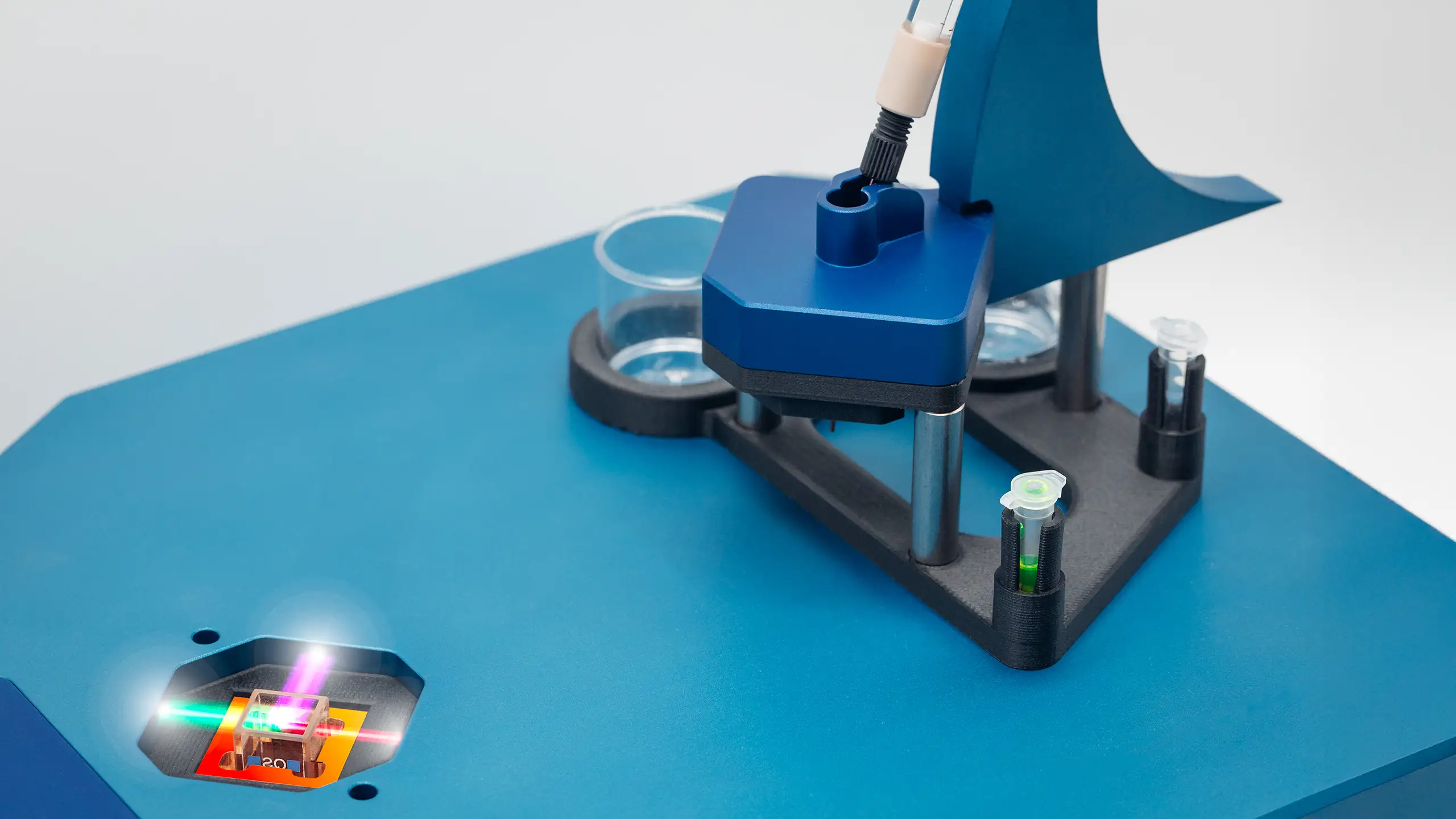
This Enables You to:

Understand the True Mechanism
Identify root causes of instability before the CMC transition. Labbot’s multimodal sensors decouple structural flux from aggregation in one timeline. This provides the mechanistic clarity to distinguish benign phase separation from terminal denaturation, ensuring only robust candidates advance. Catch predictable developability failures early by applying manufacturing stresses.
Discover Which Conditions Matter Most
Map the developability sweet spot with high-resolution automated precision. Labbot identifies the exact chemical tipping points where your formulation becomes robust. By front-loading manufacturing-relevant conditions, you define optimal environmental windows early, ensuring structural integrity is protected throughout the pipeline. Transition from trial-and-error to definitive characterisation to secure your high-value assets.
Gain Reproducibility and Context
Achieve unmatched data integrity through automated experimental control. Labbot removes human variation by delivering titrants with 20 nL resolution, ensuring every study is perfectly reproducible for regulatory filings. Meanwhile, synchronising four detection modes provides the comprehensive multimodal context needed to correlate conformational and colloidal responses in a single, gap-free record.
Identify the System's Boundaries
Define safe operating windows for manufacturing long before the pilot plant. Continuous multimodal scanning identifies the narrow environmental cliffs that discrete snapshots miss. Pinpoint precise pH stability floors for viral inactivation or determine critical phase boundaries early. Identify late-stage failures today to eliminate scale-up uncertainty and ensure a robust hand-off.
High-Throughput Data
→ High-Density Data
From Screening for Hits to Characterising for Survival
High-throughput screening (HTS) is the industry standard for broad discovery—it is the right tool for finding hits in vast libraries. But finding a hit is only half the battle. Labbot represents the next stage of the pipeline: High-Density Characterisation.
While HTS captures static snapshots of thousands of samples, Labbot provides the continuous, high-resolution record required to understand how your lead candidates behave when pushed to their limits. By front-loading manufacturing-relevant stressors early, Labbot identifies the biophysical "red flags" that HTS cannot see, ensuring you only hand over candidates to CMC that are built to survive the clinic.
High-Density Characterisation in Practice
The Labbot platform is engineered to provide clarity where conventional, discrete methods leave gaps. While versatile across a range of biophysical applications, the system is uniquely optimised for a set of signature workflows where continuous, high-density data is essential for deciphering protein behaviour.
Continuous pH-Stability and Viral Inactivation Profiling
During downstream processing, monoclonal antibodies must survive a low-pH viral inactivation hold (typically pH 3.5–3.7 for 30–60 minutes) — a high-risk zone for aggregation.
The DMAPTM performs a continuous pH sweep in a single cuvette, correlating conformational onset (via fluorescence) with aggregation onset (via SLS) to define the precise stability floor. This replaces the traditional approach of preparing 10–50 discrete buffers followed by SEC snapshots.
Isothermal Phase Boundary Mapping
High-concentration antibody formulations (100–200 mg/mL) for subcutaneous delivery are prone to liquid-liquid phase separation (LLPS), causing opalescence and viscosity spikes.
The DMAPTM maps the critical concentration and solubility boundary in automated isothermal titrations, including reentrant condensation behaviour where proteins precipitate upon addition of multivalent ions and redissolve upon charge inversion.
Manufacturing Shear Stress Simulation
Pumping and filtration subject proteins to fluid shear and interfacial stress that can trigger amyloid fibril formation.
The DMAPTM provides controlled, reproducible shear (up to 1,200 rpm) while simultaneously monitoring ThT fluorescence and SLS — distinguishing amyloid fibrils from amorphous aggregates and generating kinetic data consistent with the Finke-Watzky 2-step nucleation mechanism.
Thermal Stability and Cooperativity Assessment
The DMAPTM determines melting temperature (Tm) using label-free intrinsic tryptophan fluorescence (F350/F330 ratio) during a precise Peltier-driven thermal ramp. This avoids both the throughput limitations of DSC and the artefact risks of dye-based DSF, and handles high-concentration samples without dilution — critical for multi-domain proteins like ADCs where subtle changes in domain cooperativity predict shelf-life outcomes.
Binding Isotherms and Excipient Screening
Binding affinity (Kd) measurements for ligands and excipients are frequently distorted by the inner filter effect (IFE), where the sample's own absorbance interferes with fluorescence.
The DMAPTM measures the full UV-Vis spectrum at every titration point and applies an automated geometric correction factor, recovering accurate binding parameters even in the presence of high-concentration, absorptive excipients such as phenol or surfactants.
LLPS-Mediated Fibrillation and Liquid-to-Solid Maturation
In certain biologics, liquid condensates formed during LLPS act as staging grounds where local concentrations exceed several hundred mg/mL, dramatically lowering the kinetic barrier for nucleation into solid amyloid fibrils.
The DMAPTM decouples three distinct maturation stages in real time: rapid droplet formation (SLS), a lag phase where droplets remain liquid, and sigmoidal maturation into ThT-positive fibrils — providing critical data for setting manufacturing hold-times.
Trusted by Science Leaders
Labbot was born at the bench to solve the real-world challenges of protein characterisation. Today, it is the platform of choice for scientists in pharma, food tech, cosmetics and academia who demand mechanistic clarity—not simple pass/fail results.


Applying biophysical principles to understand protein self-assembly and stability, with the goal of designing advanced protein-based materials for drug delivery and improving the safety of biopharmaceutical formulations.


Investigating the molecular mechanisms of protein aggregation and chaperone action, with a focus on neurodegenerative disorders like Alzheimer's and Parkinson's disease.


Applying advanced biophysical methods to study intrinsically disordered proteins, with a focus on their role in synaptic plasticity and regulating enzymatic reactions within biomolecular condensates.

Advancing bio-inspired materials design by exploring the structure-function relationships of biological macromolecules like silk, elastomeric proteins, and enzymes to create advanced, sustainable materials.


Controlling protein solubility, assembly, and aggregation, with a focus on the biophysics of Liquid-Liquid Phase Separation (LLPS) and amyloid fibril formation in health, biotechnology, and food science.